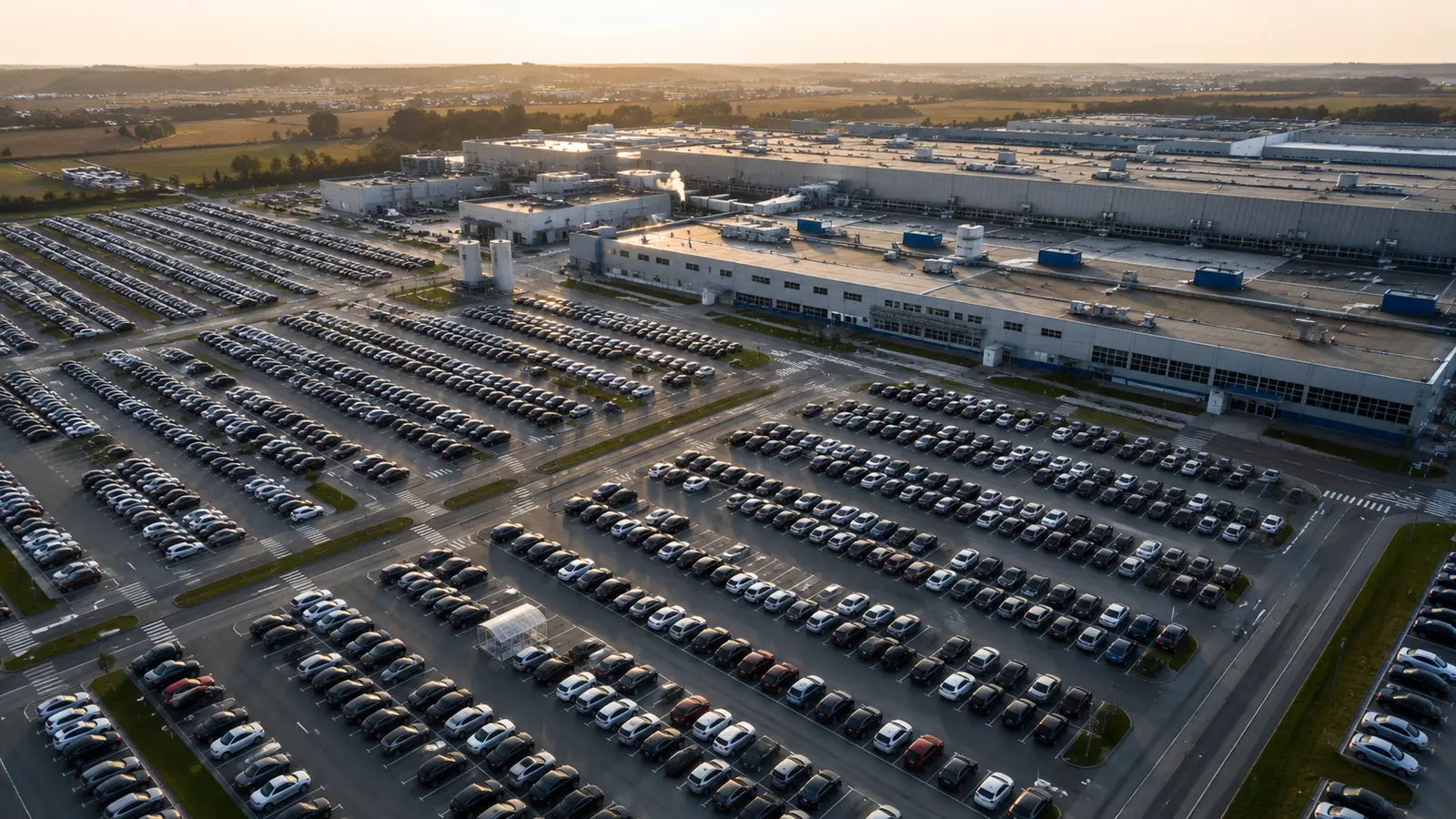
Manufacturing companies face a challenge that rarely appears in office environments. Employees commute to shifts at unusual hours, often to locations far from cities where public transport is practically nonexistent.
The scale of the problem is significant. Across Europe, millions of production workers drive alone to factories and warehouses every day. This generates costs, pollution, and parking problems that companies must solve on their own.
Why traditional solutions fall short
Company shuttle buses seem like an obvious solution, but in practice they have serious limitations. Fixed routes cannot adapt to employees' changing needs. One delayed trip means an entire group arrives late. Costs grow proportionally with the number of routes, and empty seats in a shuttle are wasted money.
Public transport? In many industrial locations, it simply does not reach. And even where it exists, schedules rarely align with shift times.
How carpooling works in a manufacturing company
The inOneCar app changes how employees organize their commutes. The process is straightforward:
- An employee downloads the app and joins the company group using a code or link from the employer.
- They set their home address and shift schedule.
- The algorithm automatically suggests co-passengers from a similar area with matching schedules.
- Employees arrange a shared ride with a single tap.
The entire process requires no HR involvement or additional coordination. Employees organize rides themselves, while the company has full visibility into statistics and savings.
Real benefits confirmed by companies
Companies that have implemented carpooling with inOneCar report concrete results:
- Parking demand reduced by 20 to 40%. For manufacturing plants with limited parking, this is often the decisive argument.
- Better punctuality. When employees commute together, mutual accountability motivates timeliness.
- Employee savings of 80 to 150 EUR per month on fuel and vehicle wear.
- Lower employee turnover. Commuting is one of the most frequently cited reasons for leaving a job in the manufacturing sector.
Step by step implementation
Implementing carpooling in a manufacturing company with inOneCar takes 3 to 5 business days:
Day 1. Configure the company group in the admin panel. Set the plant location, shifts, and program rules. Day 2. Communicate to employees with informational materials, posters in locker rooms and bulletin boards. Day 3 to 5. Employee onboarding. Technical support and first rides.
No infrastructure investment is needed. No HR process changes. No additional equipment. Just a smartphone and willingness to share a route.
Carpooling and shift work
Shift work presents a specific challenge, but carpooling handles it surprisingly well. The inOneCar algorithm accounts for shift start and end times, matching co-passengers with identical or similar schedules.
Moreover, regular shifts mean regular routes. These are ideal conditions for carpooling because employees can create permanent ride groups that function like a private minibus, but without the costs and limitations of traditional transport.
Summary
Carpooling is not a passing trend. It is a practical tool that solves real problems for manufacturing companies: from overcrowded parking lots, through high commute costs, to recruitment difficulties in remote locations. With inOneCar, implementation is fast, free for the company, and immediately felt by employees.